What insurers told us about AI and legacy technology
At a recent breakfast briefing, we asked attendees two simple questions. First, where are they currently seeing the greatest opportunity to use AI to tackle legacy technology challenges? Second, what is making this difficult to implement in practice?
The responses were revealing. Nobody needed convincing that AI has potential. Attendees could already see practical opportunities across underwriting, technology, operations and data. But the second set of answers showed why progress often feels slower than the pace of the technology itself. The challenge is no longer spotting the opportunity. It is working out how to apply it safely and effectively inside a live insurance business with legacy platforms, fragmented data and critical processes that cannot simply be switched off.
This was not a formal survey and the sample size was small. But the responses were detailed enough, and consistent enough, to highlight some important themes for insurers and brokers thinking about how AI can help tackle legacy technology challenges.
1. The opportunity areas are broad, but some use cases stand out quickly
The clearest opportunities were not abstract. They were rooted in specific tasks and bottlenecks that people are already dealing with.
For underwriting teams, intelligent document processing stood out strongly. Attendees pointed to the potential to extract information from broker submissions and emails, reduce manual data entry and keep people focused on verification rather than rekeying. Others highlighted the opportunity to use AI to understand legacy code, support modernisation work and speed up technical activities such as mapping, scripting and regression testing.
There was also interest beyond core change programmes. Some responses focused on support tickets, first-line support and security monitoring. Others pointed to the potential for AI to analyse trading and portfolio data more quickly and deeply than traditional data team methods often allow.
The picture that emerged was not one of a single breakthrough use case. It was much more varied than that. AI is being considered across application engineering, process automation, document processing, technical operations and data analysis.
.png)
Table 1: Where attendees currently see the biggest opportunities
2. The barriers are more consistent than the opportunities
If the opportunity areas were wide-ranging, the barriers were more tightly clustered. Several themes came through repeatedly.
The first was data. Poor quality data, siloed sources and accessibility issues are still limiting progress. One response put it neatly: AI will expose inconsistencies, not fix them. That is an important point. Many organisations are hoping AI will help them work around long-standing data problems. In reality, it often makes those problems more visible.
The second theme was risk inside live operations. Attendees were clear that many of the most obvious opportunities sit close to important business processes. You cannot simply pause trading, underwriting or operational workflows while you redesign the underlying technology. That raises difficult questions about sequencing, parallel running and how much change the business can absorb.
The third was skills, ownership and adoption. Organisations need people who understand both the business workflow and the technology. They also need clarity on who owns AI initiatives, how priorities are being set and how trust in the tools is built. That is before you even get to the wider challenge of governance.
And governance featured strongly. Several responses questioned whether existing controls are set up for this new environment. As AI becomes more capable, the need for oversight does not disappear. If anything, it becomes more important.
“AI will expose the inconsistencies, not fix them.”
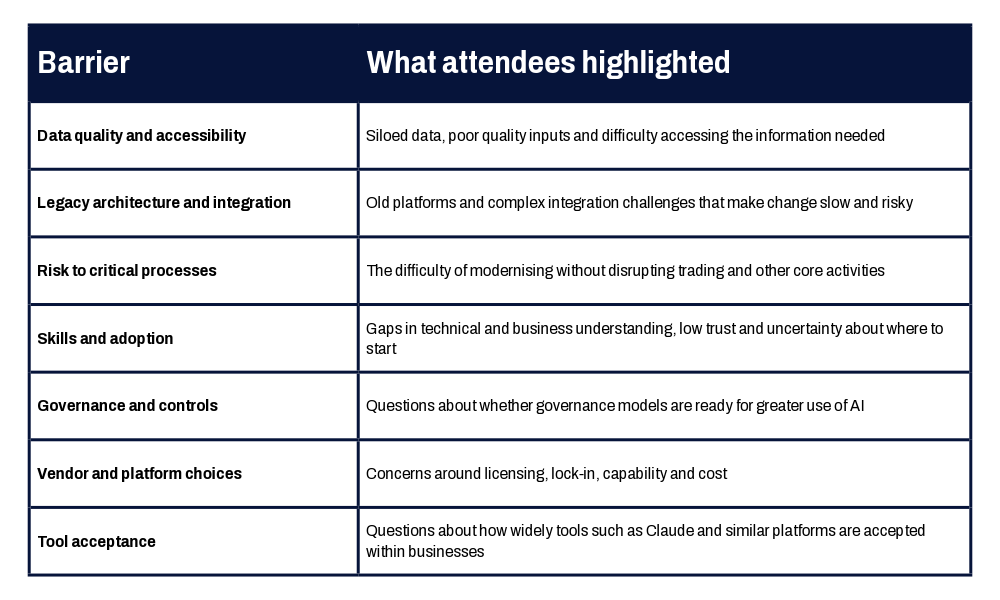
Table 2: What is making implementation difficult in practice
3. The gap between possibility and production is now the real issue
Perhaps the most important takeaway from the responses is that the conversation is shifting. A year ago, many discussions about AI in insurance were still centred on whether the technology was relevant. That is no longer the main question.
The stronger message now is that organisations can already see where AI might help. The bigger issue is what it takes to move from isolated use cases or interesting experiments to reliable operational capability.
That is a more demanding conversation. It involves architecture, governance, process design, operating models, data foundations and change management. It also forces organisations to be more precise about which problems they are trying to solve. Not every bottleneck requires AI. Not every manual process should be automated. And not every piece of legacy technology needs to be ripped out in order to make progress.

4. Five questions now sit at the heart of the discussion
The attendee responses also pointed towards a set of practical questions that many organisations are now wrestling with:
- Who owns AI in the organisation? Without clear ownership, it becomes difficult to prioritise use cases, coordinate investment and manage risk.
- How do you decide what to apply AI to? The opportunity set is broad, so organisations need a clear way to decide where AI can genuinely improve an existing process or capability.
- If you could fix one legacy constraint to make AI easier, what would it be? For some organisations it will be data access, for others architecture, integration or technical debt.
- Do you build internally or use external partners? This raises questions around capability, speed, control, cost and how much knowledge needs to remain inside the organisation.
- How do you judge whether an AI deployment has worked? The answer will vary by use case, but organisations need to be clear about what should improve, whether that is productivity, processing time, cost, decision-making or service.
5. What the responses tell us
If there is one headline from the breakfast briefing, it is this: the opportunities are clear, but the challenges are complex and varied.
The clearest areas of opportunity are in document processing, legacy code understanding, technical operations support and data analysis. But the barriers are where the real story lies. Data quality, legacy integration, governance, skills and the risk of disrupting critical processes continue to shape what is feasible.
This is important because it suggests the next phase of AI adoption in insurance will depend less on the boldest rhetoric and more on discipline around the foundations. Organisations need to improve access to trusted data, identify where legacy technology is creating the greatest friction, modernise without destabilising the business and create governance models that can support faster change.
In other words, the challenge is no longer simply how to introduce AI. It is how to make AI work in the messy reality of existing insurance businesses.
“The opportunities are clear, but the challenges are complex and varied.”
Sign Up to TINsights
Where we share our latest blogs, industry reports and insights